






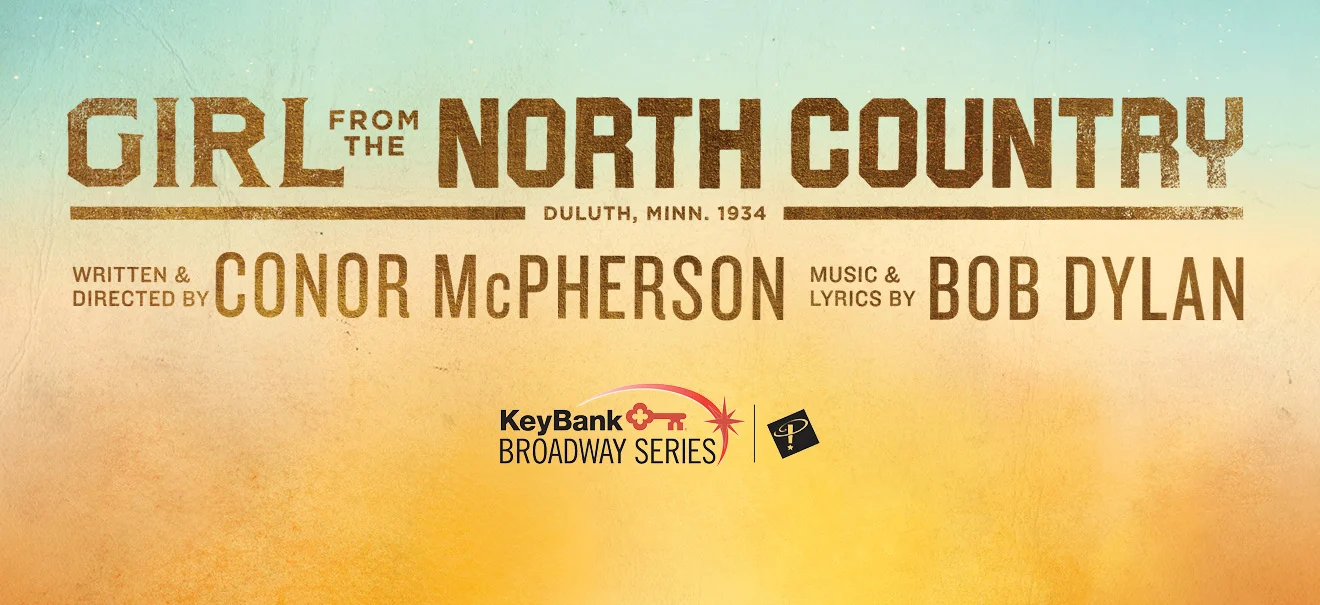
GIRL FROM THE NORTH COUNTRY, the Tony Award-winning show written and directed by Conor McPherson, is a dramatic musical that incorporates 20 of Bob Dylan’s influential and lyrical masterpiece songs.
Dylan has received countless accolades for his music over the years including the Nobel Peace Prize for literature. In Girl from the North Country, his songs are magically re-imagined by Tony Award-winning composer, Simon Hale.
The play initially opened in London in 2017. It was briefly on Broadway in 2019 but was paused due to COVID. The timeless adage, “The show must go on” once again proved true, and GFTNC now on its inaugural national tour that launched in Dylan’s hometown of Duluth, Minnesota.
Girl from the North Country may never have been written if it weren’t for a rainy-day stroll by McPherson in his native Ireland.
According to Joe Garry, host of the pre-show “Broadway Buzz” held in the Upper Allen in the Playhouse Square complex (If you know, you know! If you don’t, check it out!) McPherson was approached by Bob Dylan’s production company to write a play that incorporated Dylan’s music. Mr. Garry also mentioned that the play resembles that of a Greek tragedy, where there is a narrator and a chorus in the background.
Reportedly apprehensive at first, McPherson notes in his book that he feels that many of Dylan’s songs can be “sung at any time, by anyone, in any situation.” Many of the songs inspired the creation of the characters that McPherson introduced in the play through their struggles with mental illness, extreme poverty, unplanned pregnancies, and the negative effects of stereotyping others.
Dylan’s songs we’re very familiar! “Went to See the Gypsy,” “All Along the Watchtower,” “Forever Young,” “Hurricane,” and “Like A Rolling Stone” all appear in GFTNC.
Hale provided brilliant new arrangements and they fit the mood and emotion of the scenes beautifully. It was not a typical “jukebox” playlist of Dylan’s top hits. They were peppered into the play, sometimes with a purpose or to be thought-provoking.
The actors, who also played instruments, moved almost without notice as they made their way on and off the stage. The chorus was accentuated by choreography from Lucy Hind. Sometimes characters moved as dark, faceless silhouettes; others their movements were unique and captured the audience’s attention. Sometimes they moved as couples with more traditional dancing of the era.
The costumes and scenic designs (Rae Smith) were modest, yet still captured the mood of the Great Depression era. The characters were dressed in well-worn clothing and depicted a glimpse of what their professions and societal status might have been before the crash of 1929. The set had screens that dropped down from the ceiling, changing the location of the events in the script. There was also a large movie screen that displayed additional scenes that supported the play and brought a different dimension to the set. The visual elements helped immerse the audience in the characters’ day-to-day lives and contributed to the overall atmosphere of the musical.
[videopress Y6D1CeB8 w=800]
Act I opens with no formal introduction. The characters begin walking casually onto the stage while the audience quickly settles down just in time to see them taking their places. The stage has a small drum set on one side and an old upright piano on the other. The stage is darkly lit, and the play begins in a dreary run-down family home that has been modified into a guesthouse.
The actors and musicians, now in place, are singing and playing Bob Dylan’s song “Sign On the Window.” At this point in the play, the narrator, Dr. Walker (Alan Ariano) approaches a microphone placed at the front side of the stage and begins to describe the bleak scene that takes place in the winter of 1934 in Duluth, Minnesota. There is a stove, a table, a few chairs, a piano, and a dresser. He introduces Nick Laine (John Schiappa), the proprietor of the guesthouse and his wife, Elizabeth Laine (Jennifer Blood).
Nick Laine, the owner of the guesthouse, has not done well financially, and his guesthouse is on the brink of foreclosure. His wife has dementia and unpredictable outbursts, showcases her wit and sarcasm, providing impromptu levity throughout the play. Their son, Gene Laine (Ben Biggers), who is an aspiring writer, is unemployed and a chronic alcoholic. Their daughter, Marianne Laine (Sharaé Moultrie), is pregnant and unwed. She was adopted as a baby by the Laine’s when she was left behind by her parents.
As we moved through Act I, there were notable acting and musical performances that displayed the amazing talents of the cast and musicians. Mrs. Neilsen (Carla Woods) sang “Went to See the Gypsy,” which was soulful yet still had the trademark Dylan folk style. Reverend Marlowe (Jeremy Webb) and Joe Scott (Matt Manuel) and the cast sang “Slow Train,” which was very soulful and fit troubled history. Marianne Laine’s (Sharaé Moultrie) “Tight Connection to My Heart (Has Anyone Seen My Love)” rendition was very melodic and moving.
Blood, in the role of Elizabeth Laine, was marvelous; she could easily sing, cry, yell, and argue all while crawling around the floor looking for her handbag or money box. She also sang ”Like a Rolling Stone” and it was incredibly powerful.
Biggers, in the role of Gene Laine, and Chiara Trentalange as Kate Draper sang “I Want You” and one could feel their heartfelt emotion during this duet.
In the role of Joe Scott, Matt Manuel sang a beautiful arrangement of “Hurricane.” He was deprived of a round of applause when the play moved abruptly to the next scenario. Elias Burke (Aiden Wharton) sang “Duquesne Whistle” and he was brilliant. The song is fortuitous in that one can sense that something tragic is going to happen. The last song, “Forever Young” is sung by Moultrie before the narrator closes the show with a brief life summary of the hosts and tenants of the guesthouse.
Act II provided some revelations and conclusions that were both unpredictable and yet not surprising. In some cases, McPherson allowed for one’s creative license to determine how some events ended through their own lens and interpretation. This is unlike any other play that McPherson has written in the past and the style may not be as expected. The play is a true work of art. Do not take a shortcut, but see it through to the end and enjoy the many talents of the cast and musicians.
I found the show to be captivating, even though it is a dark and tragic story, but one that was all too common during the Great Depression. There were glimmers of hope and renewal in the storyline as everyone’s ending was not the same. It’s possible to leave the show grieving and sad yet simultaneously laughing and hopeful.
PERFORMANCES OF GIRL FROM THE NORTH COUNTRY RUN AT PLAYHOUSE SQUARE’S CONNOR PALACE THEATRE THROUGH SUNDAY, NOVEMBER 19. COMPLETE SHOW AND TICKET INFORMATION CAN BE FOUND ON CLEVEROCK’S EVENT CALENDAR: HERE!
The Review
GIRL FROM THE NORTH COUNTY
IRL FROM THE NORTH COUNTRY, the Tony Award-winning show written and directed by Conor McPherson, is a dramatic musical that incorporates 20 of Bob Dylan’s influential and lyrical masterpiece songs. Dylan has received countless accolades for his music over the years including the Nobel Peace Prize for literature. In Girl from the North Country, his songs are magically re-imagined by Tony Award-winning composer, Simon Hale. The play initially opened in London in 2017. It was briefly on Broadway in 2019 but was paused due to COVID. The timeless adage, “The show must go on” once again proved true, and GFTNC now on its inaugural national tour that launched in Dylan’s hometown of Duluth, Minnesota. Girl from the North Country may never have been written if it weren’t for a rainy-day stroll by McPherson in his native Ireland.
PROS
- Great music; acting; costumes
CONS
- storyline was difficult to follow
Review Breakdown
- Acting
- Music
- Choreography
- Story

 © 2025 CleveRock Music Portal. A PROUD SHAPE CLEVELAND PRODUCTION