







Longtime host of the widely popular Prarie Home Companion show on NPR (1974 – 2016), Garrison Keillor’s voice is one of the most recognizable that one will ever hear. Phoning into CleveRock’s hotline, Keillor’s voice sounded as familiar as ever; the voice that I heard so often during car rides with my grandparents, parents, aunts & uncles, and neighbors. This interviewer generally writes features on musicians and bands, and from a young age, my ears were tuned to the popular music stations on the FM dial. I didn’t care much for talk radio (and still don’t). Interviewing someone such as Keillor is a bit out of my element, but I know my grandmother is looking down and smiling that I had the opportunity to do so.
“You associate me with the elderly,” were Keillor’s first words to me after I prefaced that I was excited to speak with him, after hearing his voice over the airwaves as far back as I can remember.
My rebuttal to him is that this assessment isn’t entirely fair. After all, age is relative. 15 years ago, 70 years old seemed ancient to me. Now, my parents have both crossed the 70 threshold, and my outlook is entirely different. (They seem like they could easily make it another 30 years!)
“I’m interested in what endures over time, and it’s been 50 years since I saw the Grateful Dead. I went to a ballpark and sat on the grass with a lot of people who were smoking weed. It was Minnesota, so the weed was not particularly good, and we had to pretend to be stoned,” Keillor said dryly. (I’m no expert on weed; certainly not Minnesota weed, but it didn’t sound like he was kidding.)
“But I went to see The Dead because they were hip, and they were out there. They were not trying to appeal to middle-aged people in their fourties,” he continued.
One of the beautiful things about Keillor’s storytelling, be it fiction or nonfiction, is that it is nearly impossible to figure out the direction he is taking until he actually gets there. He tied it back to his upcoming appearance at the Akron Civic Theatre on May 26 as part of his Fifty Years of A Prairie Home Companion roadshow.
“So, I went to them as a young person, but now I’m fascinated by the fact that there are songs that were written by groups when I was young that have persisted over time,” he noted. “If I stand up in front of that crowd in Akron, Ohio and I start singing The Beatles’ ‘I saw her standing there.’:
‘She was just 17 / if you know what I mean. /And the way she looked was way beyond compare.’
They know the words, and they will sing it, and men will sing the falsetto ‘ooohs.’ Bob Dylan, not so many. Maybe ‘I’ll Be Your Baby Tonight.’ They might know that. But they will all know Van Morrison’s ‘Brown Eyed Girl.’
‘Do you remember when we used to sing / ‘Shala la la la’.
That song has persisted. The Beatles’ ‘In My Life’ has persisted, and people still know it, and they love it. Well, how much of Taylor Swift, a prodigious, ambitious, undoubtedly talented songwriter… How much of her work will still be around 50 years from now? To me, that’s an interesting question. And so, what I’m trying to do in a show is see what the audience knows. We’ll sing some with them, and I’ll sing, and maybe we’ll sing a Grateful Dead song, ‘Broke Down Palace.'”
All of the above was ‘answered’ without this interviewer asking a single question! That’s what a great storyteller can do! And, when it comes to storytelling, there are few better than Keillor.
Finally, the opportunity presented a chance to ask a question! It was a simple one. “What can somebody who is coming out to the Akron, Ohio show on May 26 expect?”
“I talk about the beauty of being an octogenarian,” the 81-year-old said.“I mean, we live in sort of an age of dread. I’m alarmed at how young people have gloomy feelings about the future. I find it alarming, and I want to try to sell them on the idea of cheerfulness. I believe in cheerfulness and that you can adopt it as a way of thinking, and it will do good things for you. It’s a sort of Midwestern stoicism. Akron is still the Midwest. Ohio is still the Midwest,” he said.
“I think I’m rambling on, and you can stop me anytime,” Keillor offered.
I wouldn’t dare! I wanted him to finish his thoughts and reach the end of his wordy journey. More importantly, my grandmother would turn in her grave if she knew I cut off Mr. Keillor and asked him to “stop rambling.”
“The philosophy is don’t agonize over things you have no effect on,” he continued. “You can change yourself. You can’t change what’s happening far away, but you can change your own life. So that’s what I want to go to Akron for. I’ve been doing this now for 50-some years, and I enjoy it more now than I did back when I was ambitious in trying to set the world on fire.”
“Okay, I’m going to stop now,” Keillor said. He paused. I paused. I was making sure that he was really done with this thought. Alas, he was. Sort of…. I laughed, telling him that he answered several of my questions in one fell swoop. And, without asking another question, Keillor had even more to say:
“It’s a great age. You have to be lucky. You have to be lucky. You’ve got to have a little bit of luck,” he said. “I’m at an age when some of my dear friends are running into dreadful problems, but it’s a great age, and the beautiful thing about it is that you take things in short pieces, and your life gets smaller. I’m having lunch with my wife and my cousin, Dan, who’s a doctor, and your life gets smaller. You focus on people you’ve known all of your life. And day by day by day, when I’m done talking to you, I’ll go upstairs to this hotel and I will sit down and go back to work on my novel. And it will come along in time, but I’m not worried about it.”

Stealing thunder from a previous interview that I read an excerpt of on Wikipedia, Keillor noted that writers “never retire.” Even at the age of 81, Keillor is still hard at work. It would be a lie to say that I follow his work closely today, so I had to inquire how he occupies his time since retirement isn’t something he thinks he will ever do.
“I finished a column. I write two columns a week. It’s on Substack, and I love doing it,” he said. {Garrison Keillor and Friends on Substack}
“750 words. I love that length. And I wrote about doing shows out west, out in the state of Washington and Idaho and what a different sort of audience it was. And I’m working on this novel, and I’m also working on a musical,” Keillor revealed. “It’s kind of a small musical about a vocal quartet. Two men; two women, who are trying to write another hit song. They’ve had one hit, and they’re trying to write the next one. They don’t like each other at all. They’re trying to write love songs while they are suffering, suffering intense despond about each other. They earnestly want to break up, but they don’t dare do it. And I find this funny. So I’m working on all these things all at one time, and I sit down and work on comedy. You have to work on it every day. You never rest. You’re always trying to do better. You can’t ever coast. I think that Jerry Seinfeld said that, and he was absolutely right. You have to sit down and do your work every single day.”
Seinfeld isn’t wrong. Keillor isn’t wrong, either.
The aforementioned Prarie Home Companion show, which Keillor hosted for more than 40 years, had its last hurrah in front of a live audience of more than 18,000 people at the famed Hollywood Bowl. Most major rockstars can’t fill 18,000 seats! (Although, in their prime, The Grateful Dead most definitely could.) His fame is bigger than most rock stars. His legacy is one to marvel at. 18,000 people showed up to say their goodbyes, not to Keillor, but to his radio program.
“I owed it to them to show up. These people had listened to A Prairie Home Companion for 40-some years, and I became a part of their lives,” he said. “I became a habit, and they were fond of me. I’m even more fond of them, but I try to keep that to myself, and I owe it to them to go out and take another turn. I thought it was going to be my last turn, but now I’ve come back doing this 50th-anniversary show, and I’m glad I did because I think it’s better in its revival than it was towards the end of its long run. I wouldn’t be doing it if I didn’t think so. I think it has gotten very, very good.”
This interviewer fondly remembers Keillor’s ‘News From Lake Wobegon’ segment on A Prairie Home Companion. I can still remember riding in Grandma’s station wagon as she would turn up the volume so we could both listen intensely. Lake Wobegon seemed real. The characters were believable and, oftentimes, relatable. Fully aware that Keillor is probably sick and tired of being asked this question in interviews, I still inquired about his inspiration for these stories.
“I lived, for a time, in a rented farmhouse up in Central Minnesota, and I located Lake Wobegon there in the center of Minnesota. It’s a dairy farming country, and it’s a very democratic culture. Everybody knows everybody else, and everybody is operating more or less on the same level,” he explained. “There aren’t rich farmers. They’re all pretty much on the same level. Maybe doctors are a sort of aristocracy, but they’re an aristocracy that is in constant contact with everybody else. It’s a Lutheran culture. And so, the people are modest and they adopt a sort of gentle crankiness as their mood. So that’s where the town is located. I think the actual stories come from my relatives, especially on my father’s side. They were farming people and they had experienced poverty. Real poverty. And they sort of climbed out of it during The Depression and then during World War II. And they were grateful. Their gratitude was very much a part of their view of the world, and mine was as well. And so I think that’s where Lake Wobegon is located. I gave the town a minority of Norwegian bachelor farmers and they are the skeptics. They are the nihilists. They are the unbelievers. They are people who deny the values of the town. But I use them for a comic purpose. I think that’s where the town comes from.”
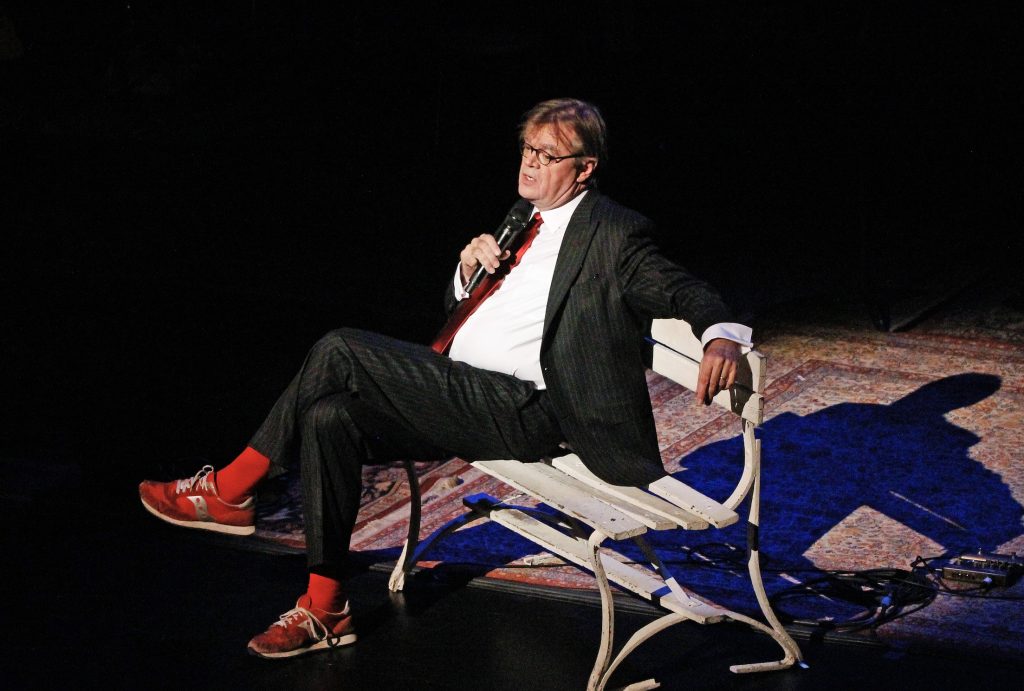
With a lengthy career in radio behind him, it only came naturally to ask him about the present state of radio. The shock jocks, the verbal equivalent of clickbait, the crassness of the hosts….What does Keillor think of radio today compared to when he started in 1974?
“I don’t listen to radio. My life has gotten smaller. I stopped listening to the radio when I stopped driving. I moved to New City after I retired because my wife loves New York. And whatever you can do to make the woman you love happy, you should do,” he advised. “And I did. And in New York, I don’t walk around with earbuds. Young people do, but I don’t. I want to listen to what’s around me and listen to conversations. And I’ve never listened to a podcast in my life. So I’m out on an odd fringe of society. I have no idea what’s on television. I only watch baseball on television. Baseball is very well suited for television. I go to the occasional movie. I go to the opera, because my wife loves opera. I go to the opera with her, but I’m completely out of touch with public radio. I hear that it’s become more political, but it doesn’t affect me at all.”
After bidding farewell to Mr. Keillor, it was time for him to turn the tables.
‘Now I think I should interview you and find out what you are listening to. What excites you musically?” He asked me.
I told him about my fondness for Americana music and named some of my favorite touring acts today. He quizzed me on whether I played any instruments and what it is about Americana music that I like the most. We had a good laugh, and he asked me if I was coming out to write a review of his upcoming show in Akron. I told him that perhaps I would!
“I wrote a book called Cheerfulness and somebody just sent me a review of that book. It was published in a magazine called The Midwest Quarterly. It was a review by a woman, Megan, she had an Irish last name, and it was the most intelligent piece of writing,” he noted. “And it was so interesting to read a review of my book. And she brought this book under intense scrutiny and she didn’t care for it entirely. It was not a rave review, but it was such an intelligent review. I just was so stunned by it. I felt honored. And so, if you should write a review of that show, I hope I get to read it.”
Well, hot damn. Garrison Keillor wants to read MY writing. Day = Made.

 © 2025 CleveRock Music Portal. A PROUD SHAPE CLEVELAND PRODUCTION