






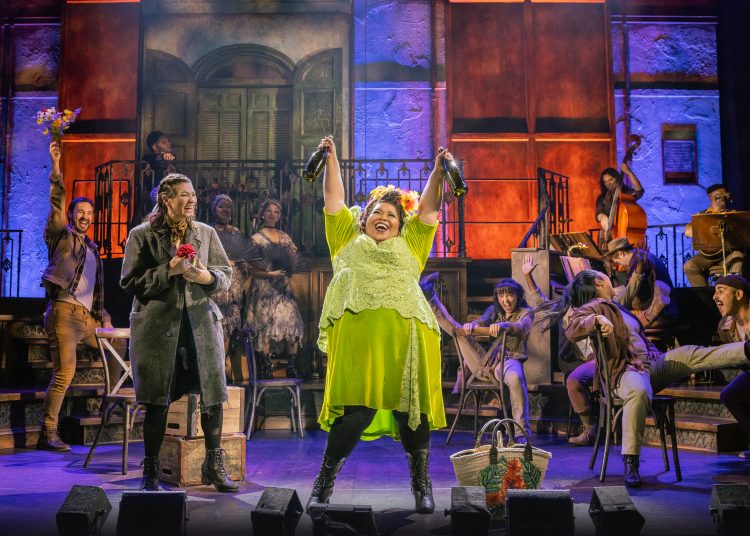
The love story between Hades, the Greek god of the Underworld, and Persephone, the goddess of spring, is known far and wide. Depicted both in mythology and in modern adaptations, there are few who are unaware of their dynamic. Lesser known is the myth of Orpheus and Eurydice, where the poet and musician Orpheus’s love–the nymph Eurydice–is killed by a snake on the day of their wedding. He journeys to the Underworld to retrieve her and is given permission by Hades to do so on the condition that he must not look back as they ascend. Hadestown, the 2006 rendition of the story, took the world by storm in true Greek fashion: live on stage.
The musical, written and composed by Anaïs Mitchell and originally directed by Rachel Chavkin, won eight Tony Awards in 2019 and the Best Musical Theater Album Grammy in 2020. It was no surprise that when the show came to Playhouse Square’s EJ Thomas Hall in Akron, crowds came in a sold-out swarm to experience the magic.
The performance had many layers of storytelling, utilizing the talent, technology, and imagination of all parties involved. Unlike most stageplays, the musicians were all on stage both immersing the cast and audience in the music as well as enlivening the scenes. Not to mention, trombonists had the opportunity to perform solos mid-stage during the musical numbers.
The first half of the show developed the story, establishing the characters, motivations, and desires. Opening with an introduction to each, as well as the band as a whole, the audience was able to join the journey versus simply watching. The vocal performance was unmatched, living up to the high expectations that had been built since the play was first brought to audiences. With the velvety-voiced Nickolaus Colon as Hades, the bold and beautiful Namisa Mdlalose Bizana as Persephone, the powerful yet delicate Megan Colton as Eurydice, and understudy Ricky Cardenas as Orpheus with an ethereal voice to match the wonder of his character’s story, the cast brought fantasy to life. Jaylon C. Crump as Hermes bridged the actors with the audience, a narrator and mentor that drove the story forward with delightfully energetic and stylistic execution. As Act One progressed, Persephone made her way from the cafe table on a balcony to center stage for her musical debut, with Hades remaining until the end of the act.
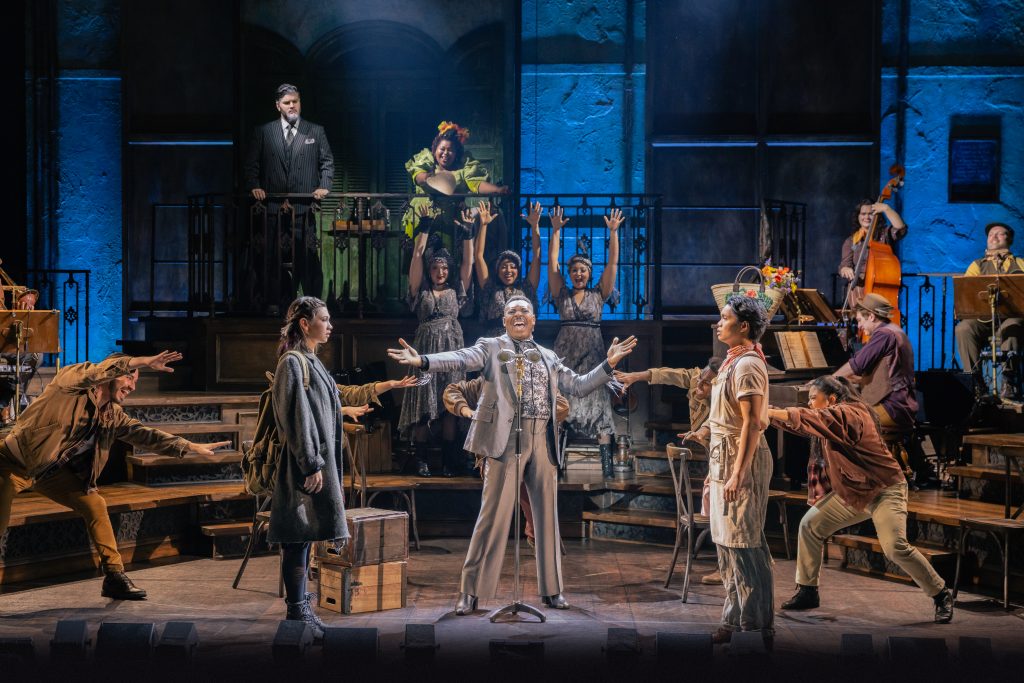
One of the key components of the musical was the set design. In addition to visible musicians, very little changed about the props and backdrops. Lighting was used to convey emotion and bring set pieces to life, while the imagination was by and large what created the scenery. The suspension of belief was strengthened by the world that was created through the storytelling and the music, with the story beats sending chills down the spines of the onlookers.
Much like the myth of Orpheus and Eurydice, the play follows her travels to the Underworld, encouraged by Hades where she will be warm and fed. Signing away her life to him, she begins to work on the wall being built around the industrial Underworld. Orpheus, absorbed by the song he is writing that will bring back spring, was shocked to find that she had left. Advised–and warned–by Hermes, he journeyed after her. Meanwhile, Eurydice begins to forget, much like the others who have sold their souls. She forgets her past life, her love, and even her own name, failing to respond when Hermes addresses her.
Orpheus succeeds in his quest, only to find out about the contract Eurydice signed. She would not be able to return, as she was no longer her own property. And so, the song Orpheus wrote to bring back spring was sung, and the melody was not a new one. It had been the song of Hades and Persephone, reminding them of their love. From there, Hades grows empathy enough to allow a chance for them to leave. As the myth goes, they trek back and Orpheus must trust that Eurydice is following. They almost reach home; however, Orpheus loses his trust, and Eurydice returns to the Underworld with Hades and Persephone, deciding to try again the next year. The cycle continues, and the performance ends with the story starting again.
The closing of the play garnered a well-deserved standing ovation lasting the entirety of the bows and bringing tears to Megan Colton’s eyes. They performed a final number to the awed audience, with the drummer emerging from backstage to be a part of the sendoff. For everyone in the room, what an experience the afternoon was.

 © 2025 CleveRock Music Portal. A PROUD SHAPE CLEVELAND PRODUCTION