






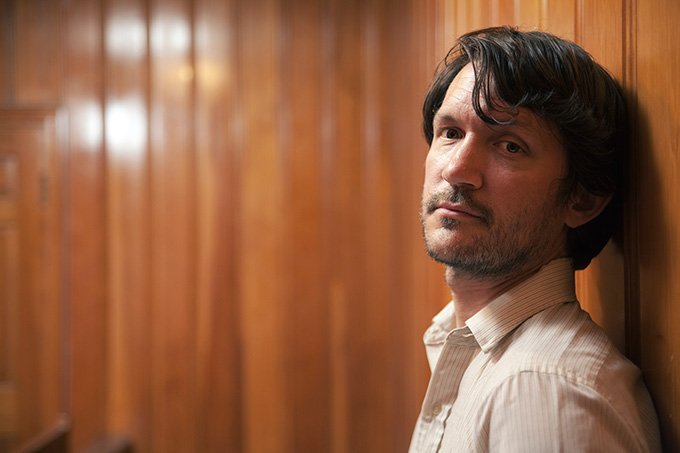
Alt-rock veterans Cursive are returning to Cleveland on April 9, supporting Bright Eyes at The Agora Theater, for what promises to be one of the best shows this Spring! The band will be performing tunes from their 2024 release, ‘Devourer,’ as well as Cursive classics from their extensive discography.
Few voices in indie rock cut as deep—or as distinctively—as frontman Tim Kasher’s. Kasher has spent over two decades crafting raw, literate music that interrogates everything from personal failures to societal breakdowns. Whether he’s snarling over jagged guitars or delivering heart-wrenching confessions, there’s always an undercurrent of brutal honesty and restless introspection.
With Cursive continuing to evolve and push boundaries and Kasher juggling solo projects and film work, he’s an artist who never seems content to stay still for long. We caught up with Tim to talk about the upcoming show with his longtime friends and fellow Omaha natives, discuss the evolution of the music industry, and reflect on his nearly 30-year career.
CleveRock: Cursive has a long history with your tourmates in Bright Eyes. You both hail from Omaha and made your first big splash in the music industry around the same time. Can you discuss your connection with Bright Eyes and what it means to be on the road with them?
Kasher: We’re excited to be on the road with those guys! We’ve known them a long time, obviously. We were all just a bunch of kids celebrating each other’s music back in the early and mid-nineties, and that just doesn’t really change, it seems. I’ve often thought it was odd that one of our good friends [Bright Eyes frontman Conor Oberst] also happens to be what I consider to be one of the best lyricists ever.
CleveRock: Cursive released their first album,‘Such Blinding Stars for Starving Eyes’ in 1997. So much has changed in the music industry since then. First, high speed internet, which led to music downloads, then streaming, then unlimited streaming services like Spotify and Apple Music. Fans seem to have shorter attention spans and, generally speaking, prefer live shows and singles over albums. Does Cursive approach anything differently in 2025 than you did when you released that first album?
Kasher: We certainly don’t approach things any differently at all. If anything, we’re probably guilty of being a little bit of kind of dinosaurs as far as I can’t separate myself from the traditional release. Albums are just what we grew up on before the nineties, like you’re saying, in the sixties and seventies. I mean, back in the fifties, they were doing albums, and that’s just a longstanding tradition that I’m still just a big fan of. I think that’s just a great way to consume music. It’s the way that it’s a template that was created well before us. Does it have to be continued? No, it doesn’t. In this day and age, you can release music any way you want, but again, back to being a grandpa and as a dinosaur, I’m more interested in hearing all the different ideas that a band or a songwriter is approaching in one given time. It’s why I prefer feature-length films versus, say, short films, which are very nice, but I’d rather tackle something more significant, I guess, when I’m consuming music or literature or, gosh, even short stories. I love that. I’m so much more interested in a book of short stories versus reading a piece in the New Yorker.
CleveRock: In my opinion, the 90s was one of the greatest times for music! Maybe it is just because those were my formative years, but I feel that there is just something so special about that decade. There are so many great bands from that era, Cursive included, that are still successful today. Can you discuss your thoughts on that decade and what it meant to be part of such a unique time for music?
Kasher: You’re kind of not wrong. If what you’re interested in is an actual alternative to mainstream music, then the 90s was a good place. It was a good time to be around because people actually still fought the power, and selling out was actually a real issue. And what that did is that it helped breed music that was truly an alternative to what the major labels were doing. And we don’t really have that anymore. Of course, we do have alternative music. We do have people in bands, such as ourselves, who are railing against that, but we don’t have a community, or the public doesn’t care about it anymore. Surely, they care about the music that would be dubbed alternative or left of the dial or whatever, but it’s no longer… You know what I’m getting at. It’s just like it’s no longer a pressing issue to work against the grain. And that was something that the 90s had in spades, which was nice.
CleveRock: Given the tumultuous state of the country, and, the world for that matter, be it politics and other forms of negativity and divisiveness, as an artist and performer, can you talk about the importance of, and your responsibility, to create an escape for fans at your live shows, even if just for the length of your set, to give people a relief from all the BS?
Kasher: That’s such a good question right now, and it’s just a really tough one, and I don’t have an answer for it. It is something I’m thinking about a lot because I do think that’s kind of two-pronged. I absolutely agree with you that, especially in this era where even people who are maybe not politically minded or who kind of choose to mostly ignore it, which I think it’s a choice, they’re still being inundated by it because they have a fucking computer in their pocket and the computer is constantly nagging at them and suggesting that they look at this or that and read this or that. In the 24-hour news cycle, what seemed like such a threat back in the 90s has become so full-blown and just is completely on steroids at this point. It’s incessant constant news, and it’s tearing us all to shreds, it feels like. when we do go and perform on a given night, I am conflicted because I do feel like this would be a great up. This is why people want to get away from that for a minute, and we can offer that. And I think that’s important. But also, we’ve never shied away from our political stance. At this time in our lives, with this current administration in particular, I feel the responsibility to say something. And mostly what I’ve been doing is just trying to say more consoling words to try to help people feel a little bit better. And I am trying to keep it short, but also, I don’t like to ignore it. So I think to ignore it, it feels to me like an elephant in the room, what’s going on right now, and it feels like something has to be said.
CLEVEROCK: Cursive is enjoying a lengthy career of nearly 30 years and released 10 albums. 30 years ago, at the band’s inception, did you ever, in your wildest dreams, imagine that Cursive would still be a successful recording and touring act in 2025?
Kasher: Absolutely not! I can’t imagine that ever, for any of the wild daydreams that I ever had growing up, this continuing… Doing this never would’ve been a consideration. But that has to do, I think, with more of a misunderstanding that a 25-year-old has about what it means to be 50. I guarantee this is a life experience that I’ve had that I know that when I was 25, I considered 50-year-olds to be people who wore suits and ties and went to work and fed their families, and I just didn’t know that there were other options available out there.
CleveRock: I know you are fresh off of a recent album and are currently on an extensive tour with Bright Eyes, but do you have anything planned for the rest of the year that you can share?
Kasher: We don’t have anything scheduled. We are actively setting up the next things, but just nothing that we could really officially announce just yet. But yeah, I think we’ll just keep at it!

 © 2025 CleveRock Music Portal. A PROUD SHAPE CLEVELAND PRODUCTION