






Author’s note:
I was thrilled to see Stereophonics’ first national tour arriving in Cleveland! I was fortunate enough to have seen the original Broadway production in New York City in 2023. I operate a website that focuses on live performances. Is it any surprise that I am a big fan of music and theater?
In my late teens/early 20s, I built two basement recording studios. (The first in my parents’ home; then in my own dwelling when I became a homeowner.)
This show is in my wheelhouse. I understand it on a level that many casual theater fans do not. (Specifically, social media warriors who b*tched and groaned about the show.)
Stereophonic is written by acclaimed playwright David Adjmi. The show boasts the most Tony Award nominations of any show, EVER! It was nominated 13 times, and took home five shiny trophies.
No, the show is not a musical. There is original music by Will Butler, a former member of indie-rock powerhouse band, Arcade Fire. The music is not the focal point of the show.
Yes, Stereophonic is long. (3+ hours).
Yes, the dialog can be slow at times.
Patrons going into the show knowing this in advance will enjoy it more. (You’re welcome!)
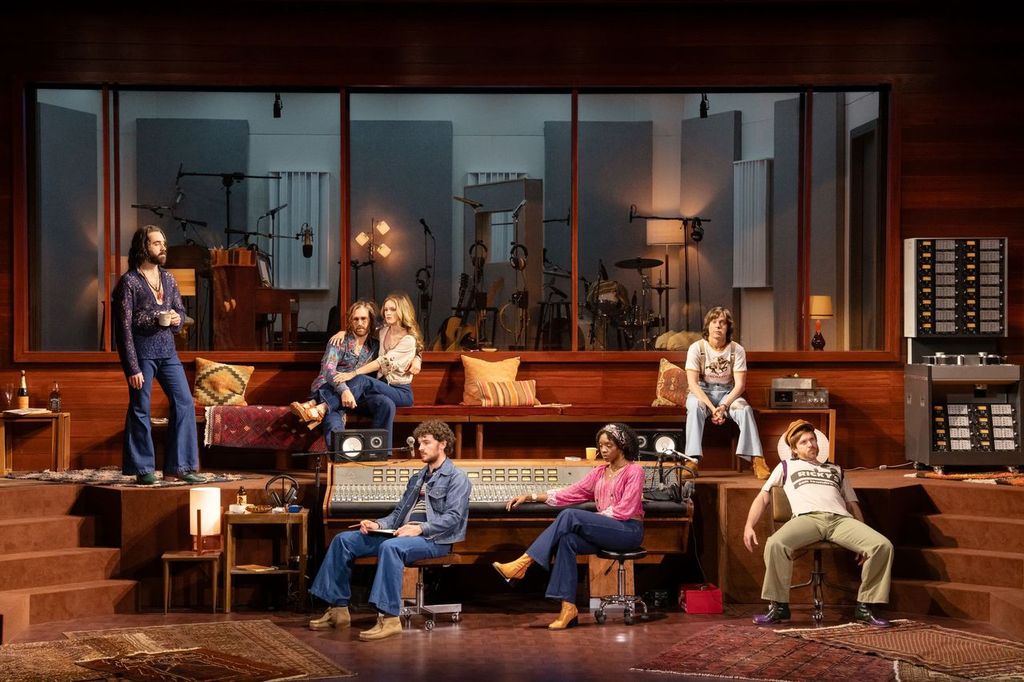
The show takes theater goers on a band’s journey in 1976 and 1977. Set inside a period-accurate recording studio, it follows the story of a band that has already achieved success and is working on a follow-up album. While there are parallels to some bands of that era, Stereophonic is not based on any single group, but rather an amalgamation of many 70s bands.
Meet the band
The fictious band includes a talented ensemble of actors. Grover (Jack Barrett) serves as the album’s engineer, a pivotal role he shares with his assistant, Charlie (Steven Lee Johnson). Together, they are the narrative anchors, with the story largely unfolding through their observations of the band and the studio audience. Their shared experiences during the intense studio sessions forge a unique bond between them.
On guitars, there is Peter (Denver Milord), who previously served as an understudy in the Broadway production of the show and is also an accomplished musician. Diana (Claire DeJean) grapples with her position within the band. Though her songs are featured on the album, she questions both her identity as a musician and her role in her partner Peter’s life.
Another couple in the band includes Holly (Emilie Kouatchou), who is the second female vocalist and plays piano & keyboards. Her husband, Reg (Christopher Mowod), is the bassist, and their relationship faces challenges due to Reg’s struggles with substance abuse and addiction.
Finally, Simon (Cornelius McMoyler – a versatile real-life multi-instrumentalist), acts as both the band’s drummer and manager. He is often the most level-headed member, providing a voice of reason within the group.
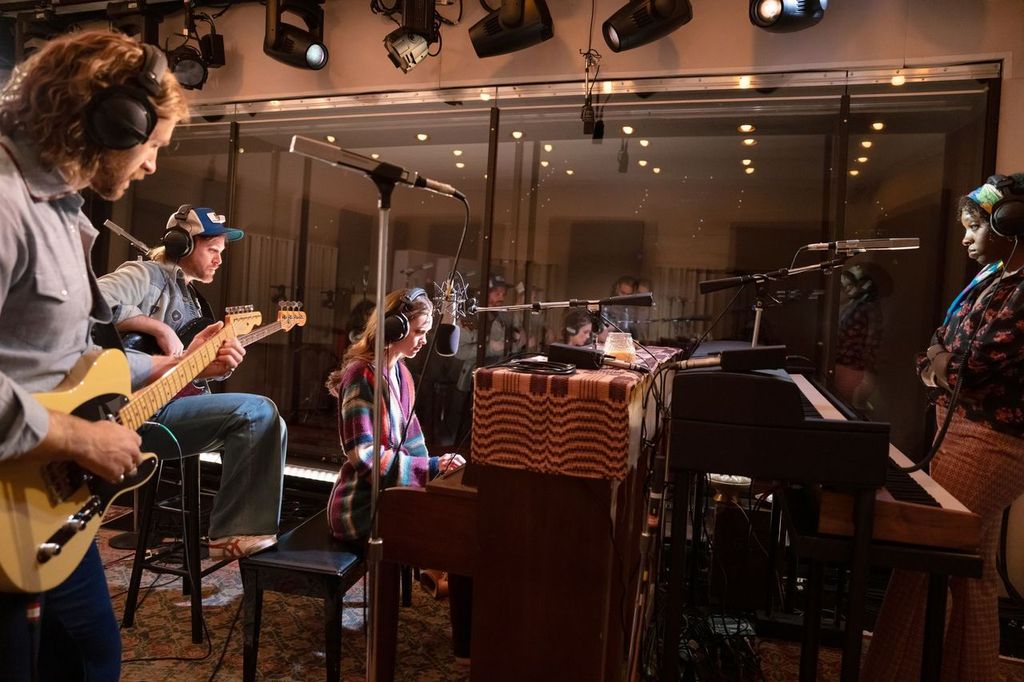
CleveRock had the opportunity to speak with Musical Director Justin Craig. He emphasized that each actor was meticulously chosen not only for their acting prowess but also for their proficiency in playing their respective instruments. While the band performs songs in the studio—sometimes fully, sometimes partially—the musical performances, though integral, are not the focal point of this show.
“It’s a think piece about a mid-level band struggling with their own limitations in the harsh face of stardom”*
*Not quite. But hey! It’s an opportunity to quote Almost Famous.
The house lights are not fully dimmed at the start of the first act. Grover walks on stage, wanting to get the studio ready for the session. Th abrupt opening helps sell the idea that the audience is, in fact, a fly on the studio wall, experiencing the band both in their creative process and turmoil.
Having been together for years and with a hit album already released, the band faces mounting pressure to create an equally or more successful follow-up. This intensifies the pressure on their current recording project. Peter, a meticulous producer and perfectionist, offers unvarnished critiques to the band, identifying areas for improvement. His partner, Diana, as the band’s most visible member, often receives the brunt of this direct feedback. Holly, generally more adaptable, is personally grappling with issues involving her husband, the bassist, Reg. Reg’s conduct, including late arrivals to the studio and disruptive behavior at their shared residence, fuels tension within the group. Simon consistently pushes the band forward and frequently serves as a mediator. As the drummer, he functions as the band’s backbone, a role he maintains both musically and interpersonally. Throughout this period, the band is shown recording and performing several songs.
Stereophonic is not a linear story with a triumphant ending. It is a series of snapshots over time. It’s not about where the band end up; it’s about what they overcome. The band experiences growing pains, and each individual’s ego is involved. (Sounds like most rockstars this reviewer has interviewed over the past 20 years!)
No one is a sinner. No one is the saint.
Dynamics including who has the most songs on the album, who writes which parts of the songs, who’s really in charge, and who says something is good enough, are all addressed during the show.
The set design for Stereophonic is a true highlight of the production. Its intricate details and numerous simultaneous events offer a depth that many audience members may not fully grasp. This is by design. A complete understanding of these nuances is not necessary to enjoy the compelling story and music. However, for those with an intimate knowledge of studio environments (i.e.; this reviewer)—the production process, equipment, and inherent challenges—the set’s meticulous attention to detail is profoundly appreciated.
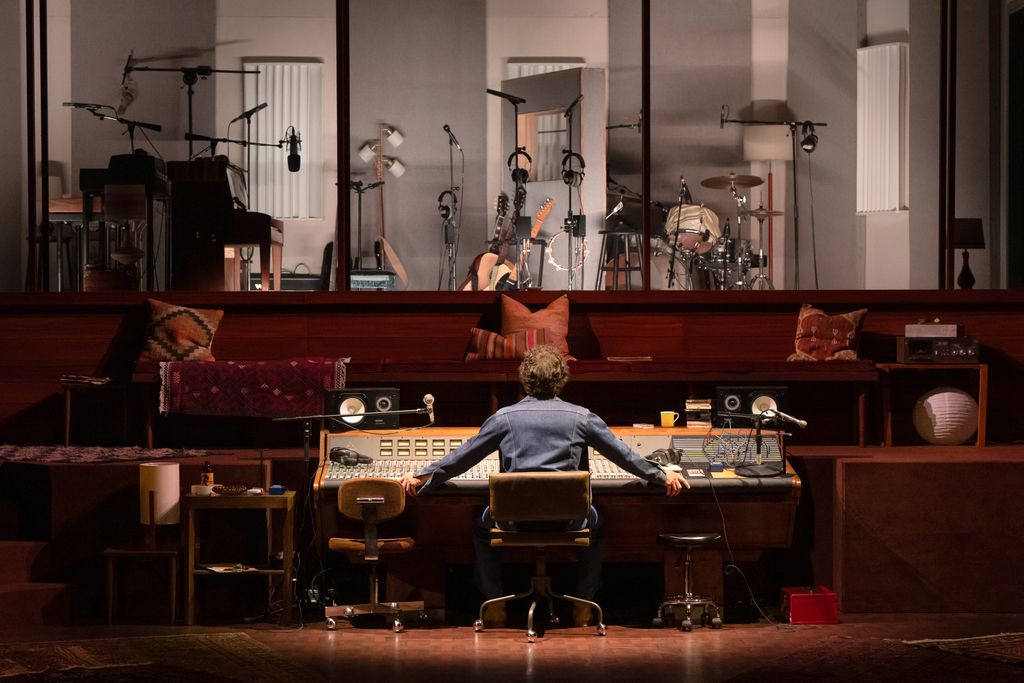
Central to the stage is the mixing console, positioned in front of the band’s “live room.” This setup means that characters Grover and Charlie primarily face the band, often with their backs to the audience. The band itself utilizes various spaces around the mixer for sitting, relaxing, jamming, discussing, and planning. Towards the rear of the stage, a genuinely soundproof live room provides a space where the band can perform, offering both the fictional audio engineers and the audience a complete sense of sound isolation.
An honorable mention must be given to the studio doors located on both wings of the stage. These doors are opened, closed, and slammed with such emotional weight that they become almost as significant as any other element on stage. Finally, the studio is littered with various “favorable substances” and a perpetually broken coffee machine, hinting at the band’s need for unconventional fuel to sustain them through long nights.
The console is a showstopper! This 28-channel mixer is a Trident Series 24, taken directly from the 70s. This prop is the centerpiece of the whole show; almost all dialogue, conflict, and magic happen while Grover is sitting behind the faders. A studio mixer is also connected to a 24-channel Studer 2-inch tape deck (the best way possible to record multitrack during that time) For perspective: the first four Beatles albums were recorded in mono, so 24 channels is a significant improvement.
When Charlie or Grover arm (set to record) any channel (or microphone), the corresponding lights on the Studer tape deck illuminate. This means the mixing console is replicating exactly what it would do if this were actually recording or playing back. When Grover hits record, the corresponding audio channels light up, and the reels of the tape machine begin to spin. When he presses rewind on the board, the tape machine rewinds. Does this need to happen for this story to work? No, not at all! This is exactly the level of detail that Adjmi, Craig, and the rest of the team desired to share with the audience.
All of the vintage instruments and microphones were available in 1976 and could, in theory, have been in a studio like the one depicted. The room allowed everyone in it to put on headphones and hear what other members’ are playing, just as one would in a true recording studio. The actors hear a raw, unpolished mix, while the audience hears a feed that is full of studio compression, equalization, gates, and reverb.
The seamless operation of this production, night after night, is a testament to the intricate coordination of numerous elements. Furthermore, every audience playback of the band’s performance is derived from the actual recording captured moments prior. Engineers individually record each microphone, using these tracks for immediate playback of the actors’ performances, including any imperfections. The precise synchronization between the live stage action and the engineer’s behind-the-scenes duplication is remarkably impressive.
It’s no surprise that two of the Tony Awards were for Best Scenic Design and Best Sound Design!
Audience members who expect a story about a band set in a studio to be mostly about the music might be disappointed. However, that is not the expectation set forth by the writers and creative team! It’s a presumption unfounded in marketing or explanation.
Each cast member was carefully selected for their roles. According to Justin Craig, their acting skills were the primary reason for their selection. The entire cast delivers peak performances. They expertly navigate three hours of demanding dialogue, conveying profound emotional depth and mastering intricate accents, showcasing an abundance of talent on stage.
DeJean’s vocal performance is particularly impressive, especially during a solo moment where she also plays the piano, creating an utterly convincing portrayal of her character.
Milord, an exceptional guitarist, navigates complex musical passages, but it is his compelling portrayal of Peter’s overbearing personality that truly distinguishes his performance. Kouatchou’s impressive keyboard talents are equaled only by her dramatic performance as Holly.
Stereophonic shares thematic similarities with the film Almost Famous, depicting a band’s necessary and challenging journey of collective maturation. While some find the duration excessively long, it is entirely justified.
Those familiar with the intricacies of music recording will appreciate the meticulous attention to detail. For audiences who appreciate a compelling dramatic play amidst a landscape dominated by musicals, this original story is a testament to exceptional acting. While predominantly dramatic, the show is not without its many moments of comedic relief.
While neither lighthearted nor an easily digestible narrative, it powerfully conveys the harsh realities of a band’s internal dynamics in a captivating manner.
For those considering attending, I highly recommend it.
Ignore the social media comments on this show. (Great advice for life in general, too!) This is a must-see production, particularly for audiences in Cleveland, the Rock and Roll Capital.

 © 2025 CleveRock Music Portal. A PROUD SHAPE CLEVELAND PRODUCTION