






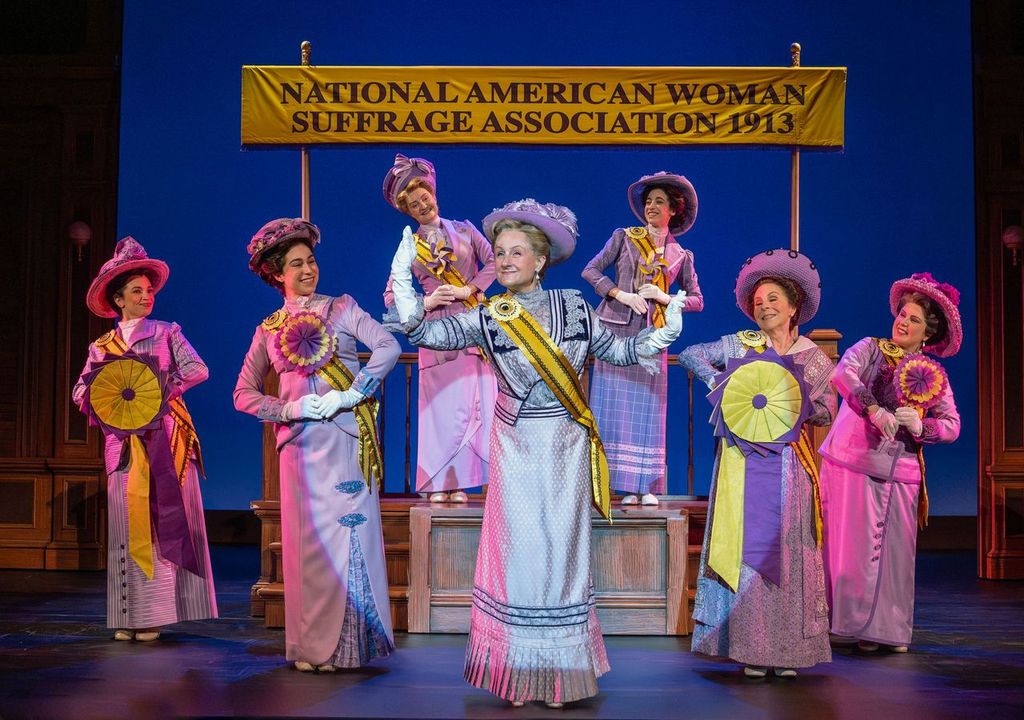
Tonight, the long-silenced voices of history rose again as performers brought to life the 2024 Tony Award–winning musical SUFFS at the Connor Palace in Cleveland’s prized Playhouse Square complex. Through powerful music and deep, evocative lyrics, the production tells the true story of the U.S. women’s suffrage movement that began more than a century ago.
Shaina Taub, the show’s writer, composer, and lyricist, became deeply interested in the suffrage movement after conversations with Rachel Sussman, who lamented how little attention history has given to the fight for suffrage. Taub was doubly inspired after reading Doris Stevens’s memoir, Jailed for Freedom, which convinced her that this story deserved to be fully brought to life on stage. In interviews, Taub has described SUFFS as her “dream project,” a deeply personal endeavor that took ten years to finally grace the stage.
The musical opens in a dimly lit setting, transporting the audience to 1913, where Carrie Chapman Catt (Marya Grandy) delivers a measured speech at the National American Woman Suffrage Association (NAWSA) convention, politely requesting the right for women to vote. Her performance of “Let Mother Vote” captures this cautious approach. By contrast, Alice Paul (Maya Keleher) takes a far more confrontational stance, and her performance of “Finish the Fight” radiates determination and urgency, highlighting the divide between the two leaders.
The all-women cast creatively dramatized the struggle for suffrage, emphasizing the clash between Catt’s cautious, state-by-state strategy and Alice’s fiery national activism. Their opposing strategies fueled tension and division within the movement, brought to life throughout the musical in songs like “She and I” and “Hold It Together.”
A pivotal moment comes when Alice proposes a bold march down Pennsylvania Avenue. With the help of Lucy Burns (Gwynne Wood), she organized the Women’s Suffrage Procession on March 3, 1913—the day before Woodrow Wilson’s presidential inauguration. Alice knew the streets would be lined with 200,000 onlookers, mostly men, many of whom might be hostile.
The audience is immediately captivated by the stage setting of the procession. Front and center, Inez Milholland (Monica Tulia Ramirez) sits high astride a white horse, clad in a flowing white gown and gold armor that catches the spotlights. Elevated above the crowd, she embodies the symbolic magnitude of the moment, leading the women forward with courage and determination. Beautiful and mesmerizing, her physical elevation mirrors her role as a symbol of strength and resolve for the movement. She is joined by Doris Stevens (Livvy Marcus) and the Polish socialist Ruza Wenclawska (Joyce Meimei Zheng). We are told that the procession included 8,000 women of every age, social status, and race.
The parade’s racial dynamics were complex: Alice proposed a separate Black delegation, asking activists such as Ida B. Wells (Danyel Fulton) and Mary Church Terrell (Trisha Jeffrey) to march at the back of the procession. Some refused to attend on principle, while others agreed in order to participate. The scene is underscored by the stirring performance of “Wait My Turn,” highlighting the courage, tension, and determination of the marchers.
During another dramatic turn, Doris Stevens is upset at being called a “bitch,” but her entourage encourages her to own the label. She does so in the satirical number “G.A.B.—Great American Bitch,” delivering the song with wit and defiance. The audience responds enthusiastically, enjoying the humor and sharp commentary interwoven into the performance.
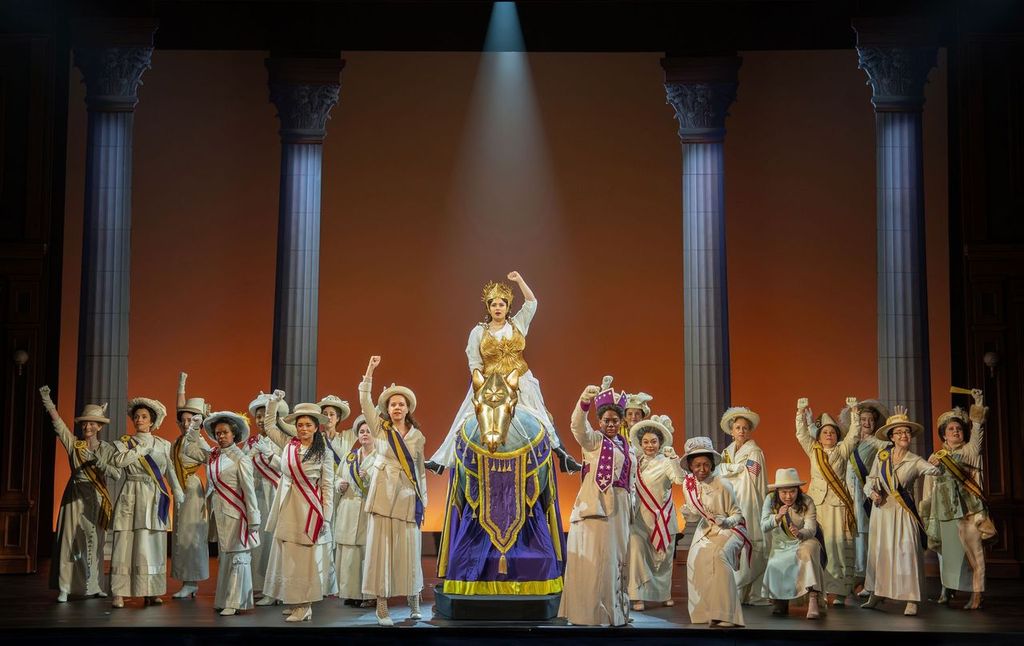
The stage design was clean and uncluttered, with set changes executed smoothly and seamlessly. The lighting was precise and deliberate, illuminating performers exactly when and where needed to enhance the storytelling. This careful coordination between lighting and performance was both accurate and highly effective, drawing the audience’s focus while supporting the emotional impact of each scene.
Paul Tazewell, a Broadway costume designer, has received many Tony and Academy Award recognitions for his superb designs. His expertise with era appropriate costumes provided additional texture that reflected the stage production designs throughout the American women’s suffrage journey.
Tazewell is the first African American male costume designer to be nominated for the Academy Award for Best Costume Design. He has received awards for his work on Wicked as well as The Wiz. He also worked as a costume designer for the off-Broadway production of Hamilton.
The story shifted seamlessly between moments of inspiration and excitement and somber reflection as the narrative progressed. During the quieter, more serious scenes, the stage was softly filled with a hint of smoke, and the lighting was adjusted to a warmer, softer hue, complementing the mood. In contrast, scenes of clarity or triumph featured a clear, smoke-free stage with brighter, cooler lighting, enhancing the actors’ skin tones and electrifying the set colors to create a vivid, pristine, and uplifting atmosphere. The lighting design skillfully mirrored the emotional journey of the story, heightening the audience’s connection to each moment.
The second act delves into more serious and intense events. Alice founded the National Women’s Party (NWP) and recruited Alva Belmont (Laura Stracko). The women stand in silent protest outside the White House, only to be arrested on President Wilson’s trumped-up orders. The ensemble performs “The Young Are At the Gates”, and while imprisoned, the women initiate a hunger strike and endure abuse, underscoring their courage and resolve. The audience is left astonished at the lengths these women would go and the hardships they endured in pursuit of women’s suffrage.
One of the most moving moments in the musical comes when Alice and Lucy set up their office in a dim basement, anchored by an old desk—the very desk Susan B. Anthony once used during her decades-long fight for women’s suffrage. On stage, the desk feels almost alive with history, a tangible link between generations, as if Anthony’s spirit pass the torch to the next wave of women to continue the suffrage movement.
The musical closes with the ensemble united in the stirring mantra “Keep Marching.” On stage, their voices rise in unison, a celebration of the courage and sacrifice of the suffragists, while also serving as a reminder that the struggle for equality is ongoing. The moment is both triumphant and reflective, leaving the audience inspired and acutely aware that the movement’s spirit marches on beyond the theater.

 © 2025 CleveRock Music Portal. A PROUD SHAPE CLEVELAND PRODUCTION