






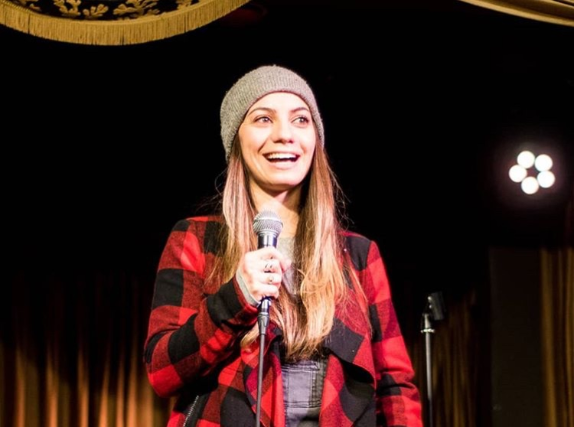
On April 12, Cleveland’s premier comedy destination, Hilarities Fourth Street Theatre, will welcome a performer who defines the modern, self-made comedic spirit. Liz Miele is not just a stand-up comedian; she is an author, a social media strategist, and a veteran of the New York City comedy scene who started her journey at an age when most teenagers are just trying to pass chemistry.
Born and raised in New Jersey into a family of veterinarians, Miele bypassed the traditional college route to dive headfirst into the cutthroat world of New York stand-up at just 16 years old. By 18, she was profiled in The New Yorker, and by 22, she appeared on Comedy Central’s Live at Gotham. However, despite these early flashes of traditional success, Miele’s career trajectory truly skyrocketed when she took the reins of her own distribution. She has since released several highly acclaimed specials, including Self-Help Me, The Ghost of Personal Vices, and The One-Hour Emotional Breakup Special, amassing millions of views by going directly to the people who find her brand of neurotic, intellectual, and fiercely honest humor resonant.
In a recent interview with CleveRock, Miele reflected on the unconventional path she took to build her career, noting that her success was born out of a necessity to bypass the industry’s traditional “tastemakers.”
“I was never really picked by the gatekeepers, and it was through YouTube, and Instagram, and Facebook, and Reddit, and all those places that I have a fan base. I mean for me, I haven’t changed and I still haven’t changed. I write what I want to write. I talk about what I want to talk about. I polish it to the best of my abilities. I try to put on a good show, but it’s first and foremost for me, and then I hope it resonates and connects with other people. I first tried to start out with a good product, and then I started over 15 years ago, cutting up my jokes and my stories and putting them out there. I was told my setups are too long and I need to get to the point. But I was always like, ‘Well, if I make the journey funny; if I’m interesting the whole time, who cares if this bit is a minute or seven minutes?’ Very early I realized that I wasn’t going to be on late night because some of my bits are longer than five minutes, let alone the fact that I wasn’t a punchy comedian. I would tell these long stories that had little punchlines along the way. And when YouTube was coming out, or even IGTV, you could have a video up that was up to 10 minutes. And so I started being my long-windedness. My storytelling started to be rewarded because the longer somebody watched the video, the algorithm was like, ‘Oh, thank God, they watched the whole video!’ Most people, even if they didn’t love me, everybody kind of knows the basic rule that the punchline is at the end. So algorithmically, they saw people finishing the video, and they pushed it to more people.”
Miele’s style is a far cry from the rapid-fire, setup-punchline-repeat rhythm of many club comics. Instead, she leans into the narrative. Her bits often feel like a frantic but well-plotted conversation with a brilliant friend who is perhaps one minor inconvenience away from a total meltdown. This vulnerability is her superpower. Whether she is discussing her struggles with dyslexia, her intense relationship with her cats (which inspired her book, Why Cats Are A**holes), or the trials of dating in your 30s, Miele finds a way to make the hyper-specific feel universal.
Much of this material stems from a place of frustration, a theme Miele is quick to acknowledge. She describes herself as someone who operates with a high level of internal heat, which she then distills into her stage presence.
“Everything and everywhere. I’m an angry person or reformed crazy person. Everything pisses me off. I think I’ve just learned to channel that anger, but also find the humor in it. Some of the things I get angry about are so ridiculous, and I have at least a self-awareness to be like, ‘This might not be the best use of my emotions and my time.’ I think having a watchful eye on just my own ridiculousness, the ridiculousness of society, how things work… I have a large male fan base, but an older male fan base. My fan base is truly between 50 and 70, and that is because I am my father. I am a hundred percent my father. You have met my father. Instead of being a short Italian man, I am a short Italian woman. That’s the only difference.”
While her reactions are genuine, Miele is also a craftsman. She understands that the distance between a funny real-life moment and a successful stage bit is bridged by editing and creative license. When asked about how much of her material is rooted in factual reality, she provided a candid look at her creative process.
“I would say by the time a joke or a story is polished, it’s anywhere from 87% to 90% true. It starts out true, but then you do some embellishing here, you do some reordering. Sometimes the way things actually happened, you have to kind of go backwards to kind of explain why you were even in this position to begin with. A good example is I’ll kind of embellish exactly what I said because the truth of the matter is I’m a very angry person. So probably what I actually said in the real world was ‘Go fuck yourself,’ just expletive. But then over time, that’s not creative. So I make it a more creative way of telling somebody off. So it’s just like a massaging of the truth, I would say. But actual events that happened, actual reactions or emotions, they’re usually 97% true.”
This commitment to authenticity and craft has made Miele a favorite among both audiences and venue owners. Her upcoming stop at Hilarities is a homecoming of sorts to a room she holds in exceptionally high regard. Known for its underground feel and historic charm, Hilarities has long been considered one of the gold-standard comedy clubs in the United States, and Miele is quick to praise the environment they foster.
“It’s one of the best rooms that has one of the best staff. There’s a level of hospitality that I would like and I feel like they go above and beyond. They care. You kind of wish you lived there so you guys could all be friends.”
The comedy world has changed significantly since Miele first picked up a microphone as a teenager in 2002. At that time, the industry was strictly hierarchical. To “make it,” a comic needed the approval of a handful of bookers for late-night talk shows or cable specials. For women, the barrier was often even higher, with many clubs adhering to unofficial “quotas” that limited the number of female performers on a single bill. Miele has witnessed the dismantling of this structure firsthand, noting how the democratization of the internet has allowed for a more diverse array of voices to thrive.
“I think it’s the death of the gatekeeper. You have to understand, the gatekeepers were predominantly men, and they booked what they liked, which I get and I respect and I understand, right? You have your taste. You like what you like, but the booker for Letterman, 15 years ago, basically was like, ‘Yeah, I don’t book a lot of female comics. I don’t think they’re good enough,’ or whatever. And you’re like, ‘Excuse me?’ So as these gatekeepers have fallen off and as the internet, social media, YouTube, whatever, now it’s a direct comedian to their audience connection. Now fans can find you and their tastes can decide if you’re successful or not, which is what it should always be. There shouldn’t be just five people deciding if your humor is what others want to see. So if you think of something like Comedy Central, their audience was 18 to 25-year-old men. So while Comedy Central was the ‘IT’ place for comedy, they didn’t really allow not only women’s voices, but a diversity of women’s voices. You have not only more women having fan bases and having an audience, but you have more minorities and with people with different backgrounds; different styles. The other thing is that we’re not just female comedians. I’m a storyteller.”
However, with that direct-to-audience connection comes a darker side. Navigating the world as a public-facing woman—especially in an industry as subjective and occasionally aggressive as comedy—comes with safety concerns that many of her male counterparts never have to consider. Miele has been vocal about the “grossness” that can emerge both in the digital comments section and in physical spaces. For her, the priority is always personal safety and maintaining a professional boundary.
“It’s endless. I think they’re definitely more emboldened online than they are in person, but you still have people that are pretty awful in person. I think what I feel really fortunate about is most clubs, male or female, will have security, and I utilize that security. I have no problem saying, ‘Hey, can somebody drive me to my hotel? Can somebody wait with me till I get in my Uber? Can somebody stand with me when I do merch?’ I do feel between my own stories and all my friends, there’s too many instances of men crossing boundaries to the utmost extent. It’s obviously not worth anything bad happening to me or anybody else. When it comes to the grossness online, I don’t get involved. If I really have a lot of fear around it, I take screenshots and I have a folder because if I have to go to the police, which I’ve had to do, I want to be prepared. In person, if I feel protected, I’ll say, ‘Hey, I don’t appreciate that.’ I have no problem telling people this person needs to leave. People buy a ticket and I’m grateful for it. But that doesn’t mean you can scare somebody or disrespect somebody. I just don’t understand how you would go to a comedy show and think that for X amount of money you’re allowed to treat somebody like garbage. I have a pretty low tolerance for people not making me feel safe.”
As Miele prepares for her April 12 performance at Hilarities, she continues to prove that longevity in comedy is about more than just being “punchy.” It’s about building a community of fans who value the “journey” of a story as much as the destination of the laugh. Whether she’s exploring her Italian heritage, or her frustrations with society, Miele brings a sharp, disciplined, and hilariously agitated perspective to the stage.
For Cleveland comedy fans, her appearance is a chance to see a master storyteller at the height of her powers—a comedian who stopped waiting for permission a long time ago and decided to build her own stage, one video and one long-winded story at a time.

 © 2025 CleveRock Music Portal. A PROUD SHAPE CLEVELAND PRODUCTION