






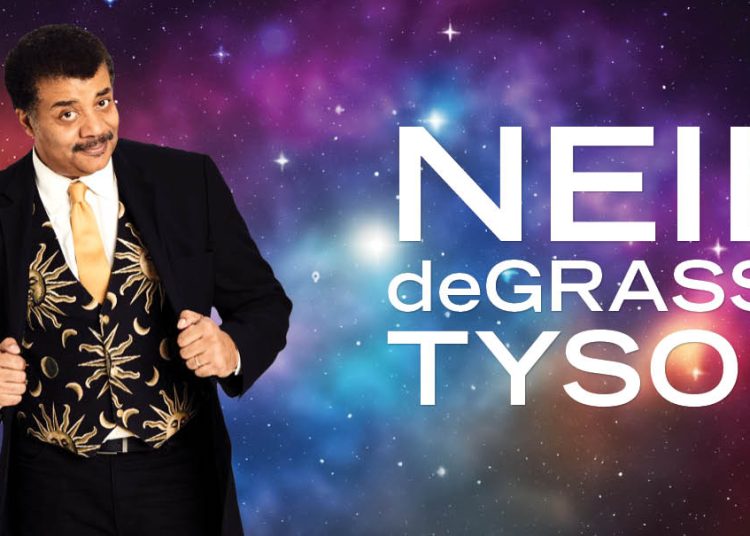
It’s not every day that I get to spend part of my afternoon interviewing a world-renowned astrophysicist – but was lucky enough to have the opportunity to chat with Dr. Neil deGrasse Tyson before his appearance at Playhouse Square’s KeBank State Theatre on Tuesday, May 7. {Details and tickets}
Dr. Tyson, head of the world-renowned Hayden Planetarium in New York City, is a science communicator best known for his work of popularizing astrophysical science and discoveries. His work spans decades, and his ability to make science palatable for all audiences while also having such a vast knowledge on the subject has led audiences to seek out his live talks. His last visit to Cleveland was a presentation titled “An Astrophysicist Goes to the Movies,” which had audiences laughing, learning, and leaving with a plethora of new science facts to share.
His upcoming talk, titled “Delusions for Space Enthusiasts,” is one of many presentations that Dr. Tyson has prepared for when he does live events. He explained that he has dozens of talks he can be ready to give, and whenever he has a live event scheduled, he lets the venue pick the subject matter from his portfolio.
“I’m really a servant of people’s interesting curiosity,” Dr. Tyson said in a recent phone conversation with CleveRock. “So I just picked what they [Playhouse Square] want me to give. So I have, like, preloaded in me, a dozen talks that I can give, and they’re updated as necessary. And current events shift as science advances and our understanding of the universe evolves. So this one, Delusions of Space Enthusiasts, that one is very ‘in your face.’ It’s like you thought this is what it was about, but it’s not. You thought we went to the moon because we’re explorers? Oh no! You know, the first scientist who was sent to the moon. Do what mission he was on?”
At this point, I had to humbly admit to an astrophysicist that I did not know the answer to this very basic question.
Dr. Tyson laughed saying, “The last mission! Everybody else served in the military who went to the moon by NASA. So, little things like that are rampant throughout our collective understandings of our past, present, and future in space.”
At this moment, it was clear Dr. Tyson could talk about science to anyone, no matter their level of understanding on any given topic. The idea of getting up on stage and explaining scientific facts and phenomena in a captivating way to a few thousand people, all with differing levels of education, sounds like an extremely daunting task. It’s one that Dr. Tyson has spent years preparing for, perhaps without even realizing he was preparing.
The good doctor was asked that even with his vast knowledge of sciences, how he takes said knowledge and makes it digestible for people of all education levels.
“That’s a brilliant question. Thanks for asking that. And I say that because I think about that at the time. And, in fact, most people don’t even know to ask that question. But it’s the sum of my life experience speaking to people in response to their questions after they’ve learned that I’m an astrophysicist. Of course, I’m recognizable today, but there was a day when no one knew who I was. But I was nonetheless an astrophysicist who would sit next to somebody on a plane…
‘What do you?’
‘I’m an astrophysicist.’
And then, out come 20 questions. And so I am, over the years I have monitored closely.” He laughed, adding, “This is how I know I’m not autistic—I can read facial expressions. First, I log what your questions are, so that gives me the priority of curiosity. But also, I notice if their eyebrows are raised. Are they leaning towards me or away from me, or neutrally? Are they so distracted by their thoughts that they order a drink?”
He went on to discuss how this fueled his decision-making as he prepared talks, saying, ” So I monitor this, and I developed methods, tools, and tactics to select information that, in my judgment, most excite your curiosity. That then becomes the sum of my talk. So I’m not delivering a lab plan or a lesson plan – that you’ve got to learn whether you like it or not...So there’s some content that, if you’re really into it, is a bit ahead of most people. But I don’t dwell on it. I just go right by it and there’s usually a really cool visual associated with it. Yeah. So that way, it keeps people engaged.“
While I could have thrown 500 science questions at Dr. Tyson at this moment, his discussion on how he prepared for a live audience really fascinated me. Not all astrophysicists have had to become experts not only in their field but also in sharing information with people (even individuals who work with people every day do not take care of social understanding the way Dr. Tyson does). When I commented on this, Dr. Tyson shared a story:
“My first appearance ever on The Daily Show with Jon Stewart. I noticed that when politicians would go on the show, they try to give their stump speech, and then he just dances circles around them, tells jokes, and they’re like a deer in the headlights because they have this research, they have this rehearsed delivery. And I said to myself, that’s not going to happen to me,” he recalled. “So I watch the show with a stopwatch and timed, on average, how many seconds his guests are given to speak before he comedically interrupts them. And I said, if I”‘m going to be on the show, I’m going to pass on my information in that way so that when he interrupts, the idea is complete, and then we can laugh at the joke, and I don’t have to resurrect to recover that moving information that I started beforehand. If you want to know what that interval is, it’s 8-12 seconds. Which doesn’t sound like much, but in banter that is sufficient. Real conversation goes back and forth with quite a bit of frequency. So I did this. Then all these comments came to my social media and my family, and back when my email was public, they said ‘Neil, you have such good chemistry.'”
He laughed, sarcastically adding, “It’s natural! Yes! All natural.
After giving live talks on stage for years, Dr. Tyson has continued honing his detective-like skills of preparing and reading an audience on the fly. While it is a little different when not in front of a few thousand-person theater but sitting next to a stranger on an airplane, he continues to take the same level of care as if it were a one-on-one conversation.
” I’ll drop some commentary in the first minute of a talk just to test people’s humor level; which way they lean politically; how religious is the audience? There’s some hot-button issues that I’d like to get a reading at, which can help shape how I communicate, ” he revealed. “They’re not topics I would avoid if I were otherwise going there, but it will shape how I handle the topics. Because I want to maximize your interest in learning and what I have to say. And so it matters to me how you learn, what you care about, what you like, and what you don’t like. I care about all that…In the first few minutes, it’s a barometric test, and that shapes everything I say afterward.”
While this interviewer did not intend for this conversation to center so much around Dr. Tyson’s work on mastering his live shows, it was truly a fascinating conversation. Imagine dedicating your life to science but somehow finding the time to become a master in live discussions, too. When this was mentioned, Dr. Tyson talked about how important nonverbal cues and notions are in these massive theater talks as well.
“I used to dance. I was a performing member of three different dance clubs in college,” he said. “When you dance, you learn firsthand, and you know what role the rest of your body plays in the art of communication. The dancers are speaking to you. They’re just moving their limbs, and their torso, and their head. And so, when I am communicating, I will almost always fold into my sentences some gesture or actions of my body…For me, the deliverer of the content, there is more information for you to draw upon than just the words out of my mouth.”
Considering all of this knowledge and the work Dr. Tyson has put into these talks on various subjects, there is a myriad of information one could take away from seeing him live. Perhaps a newfound love for space or a deeper understanding of the importance of science.
“The fact that science is not just some topic that you were forced to take in school and you were glad it ended and you sold your science book. Science is a fundamental part of our lives,” he said. “And the decisions we make about the future of civilization; all of my talks have that in common. Every single one of them. There’s some element of ‘I’m now more scientifically enlightened.’ And you’ll walk away saying I want to ingest more science than I have before. I want to tell more people about the science I just learned. I want to show people that science can be and is. Just as fun and entertaining as anything else you might go to a theater and observe. “

 © 2025 CleveRock Music Portal. A PROUD SHAPE CLEVELAND PRODUCTION