






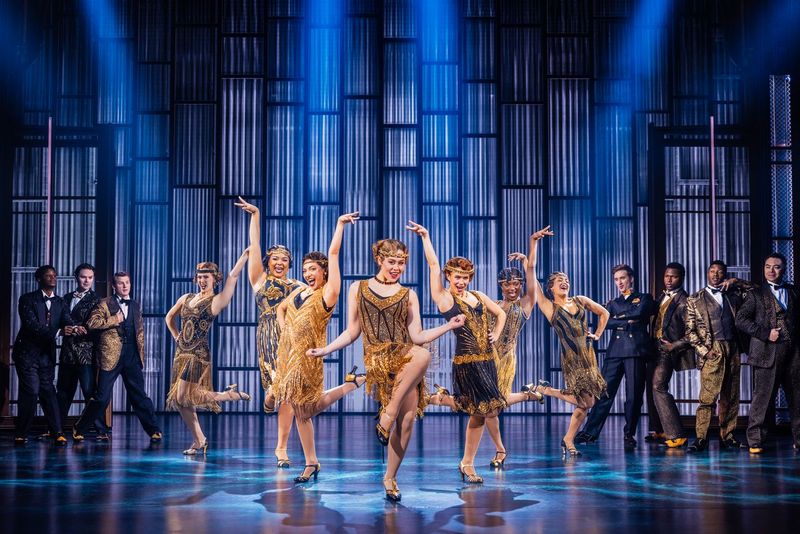
The green light at the end of Daisy’s dock is glowing — and this time, it’s shining all the way to Cleveland. The Tony Award-winning Broadway musical The Great Gatsby brings its dazzling national tour to Playhouse Square beginning June 9 and running through June 28, 2026, and if the production’s reputation precedes it even half as well as Jay Gatsby himself, audiences are in for something extraordinary.
When the show opened on Broadway in April 2024, it didn’t just arrive — it announced itself. Critics scrambled for superlatives.
The New York Times called it “a dazzling, lush, and bewitching production. Entertainment Weekly went further still, calling it “a Broadway extravaganza that explodes with life and energy.”
The show earned a Tony Award for Best Costume Design in a Musical, recognizing Linda Cho’s breathtaking period work, and collected four Outer Critics Circle nominations with two wins.
For anyone who somehow missed the assigned reading in high school English class, here is the short version: F. Scott Fitzgerald published The Great Gatsby in 1925, and it was, by most accounts, a commercial flop. Fitzgerald died in 1940 without knowing what his slim, Jazz Age novel would become. It wasn’t until a wartime distribution of the book to American soldiers and a classroom revival in the 1950s that the novel found its true audience — eventually ascending to the status many now consider the Great American Novel.
The plot follows Jay Gatsby, a mysterious self-made millionaire on Long Island, whose relentless pursuit of the beautiful Daisy Buchanan becomes a meditation on obsession, class, illusion, and the seductive cruelty of the American Dream.
Kyle Caress, a swing and Dance Captain for the touring production, puts it plainly:
“It’s a story that follows the American dream and it’s about the things that you would and wouldn’t do for love, I suppose.”
Caress is one of a select few performers entrusted by the show’s celebrated choreographer, Dominique Kelley, to teach the production’s extensive and intricate choreography to others — a distinction that speaks to both his technical mastery and his deep understanding of what makes this particular show move the way it does.

When asked how well the creative team translated Fitzgerald’s novel into a live theatrical experience, Caress was enthusiastic. “They did a great job,” he said. “The really exciting part about this musical adaptation is that it does follow so much of the plot from the original book, of course. I think it captures the opulence and the grandness of the Roaring ’20s in a way that’s really exciting, especially nowadays in theater. It’s lush sets, beautiful costumes… It really takes the audience into that world, while also at the same time, keeping it a little fresh. There are a couple of twists in the musical that you don’t necessarily get in the book. I think it hits all of those main parts that we’re nostalgic about.”
That sense of opulence is not incidental — it is architectural to everything The Great Gatsby is as a piece of theater. But if the sets and costumes are the backdrop, the choreography is unquestionably the heartbeat of the show! In many Broadway productions, dance serves as punctuation — exclamation points between scenes. In The Great Gatsby, the movement IS the story. The choreography, conceived by Dominique Kelley (best known for his work on So You Think You Can Dance)— is woven into the fabric of every party. It is not window dressing. It is the window, the walls, and the view.
What Kelley and his team built was not simply a collection of period-accurate dances hung on a narrative frame. It was a genuine fusion of historical research and contemporary movement vocabulary, and Caress was in the room where it happened.
“There was actually a lot of research that went into it,” he explained. “Dominique Kelley, who is so incredible — he was very specific, especially in rehearsals as we were learning the material that he was choreographing. He made sure to always talk about the history of the steps that we were doing. When you come see the show, there’s a lot of style from the 1920s mixed in with the modern styles. You’ll see some Lindy Hop, you’ll see some rhythm tap, similar to the Nicholas Brothers, and you’ll see all of those elements that were very popular in that era. But at the same time, he was very intentional to mix it up with some modern styles. You’ll see street styles, you’ll see jazz, you’ll see funk, you’ll see some hip-hop elements, but he always made sure to tell us the references that he was pulling from so that it can help inform us as dancers.”
The blending of old and new is not accidental or casual — it is a deliberate artistic choice made with both precision and joy. “We’ll be doing a Charleston, which was a very popular social dance in the ’20s, but at the same time, we’re adding in a little more Afrobeats with it, or adding a little more of a modern spin,” Caress said. “I would say that the research that especially Dominique did when preparing for this was pretty immense, but he was also very intentional to make sure that we knew that we were mixing a little something old with a little something new, just to make something new and exciting that still feels like it’s in the world of the ’20s, but is also kind of more relatable to today’s generation.”
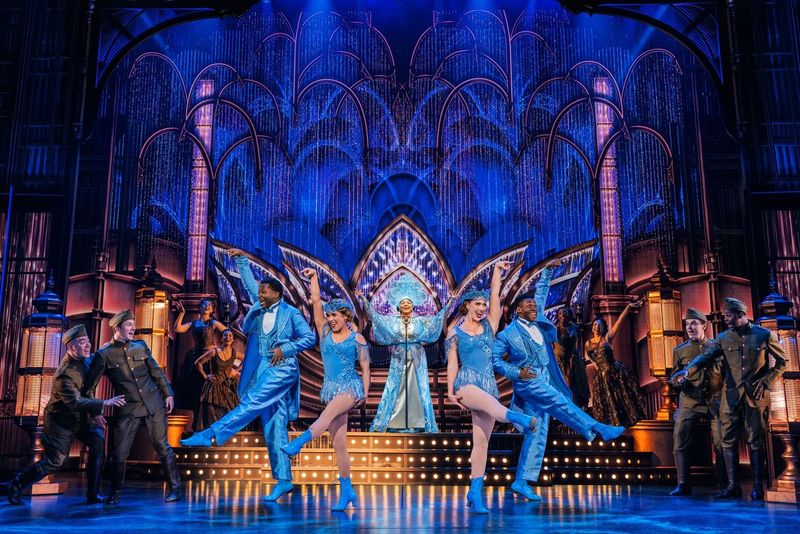
The result is a show that hits you somewhere between nostalgia and novelty — a place that is genuinely difficult to reach in the theater, and even more difficult to sustain eight performances a week. Which raises the natural question: how do you keep that kind of energy alive night after night, city after city, without letting it calcify into routine?
For Caress and his castmates, the answer comes back to a single rallying phrase they return to again and again: “Remember your why!”
“I try to go back to that,” Caress said. “It’s always someone’s first time seeing a show and it’s always someone’s last time seeing a show when you’re in an audience and you just never know who is out there and who you might inspire. I feel like just trying to take it back to the entire reason that we do this, to connect with people and to hopefully be a source of representation for hopefully someone in the audience who may see you and be like, ‘Oh wow, I see myself in you on stage.’ I feel like going back to that really helps me, not just me, but truly a lot of people in our cast. We’ll always be like, ‘Remember your why,’ especially if it’s been a string of days where we’re all just working really hard and are tired — just going out and seeing a full audience of people just clapping and giving us their energy truly, genuinely helps the cast as we go through it.”
The cast’s relationship to the choreography itself has also deepened as the tour has progressed. “I think for a lot of the dancers in the show, because we feel such a good, strong connection to this movement, we have taken ownership of it at this point to a certain extent and we’ve really kind of let that settle in our bodies,” Caress said. “Another huge way that we draw inspiration from each other to keep everything fresh in our bodies is to actually base off of my relationships with my other castmates, and I think that we’re always kind of learning and growing from each other. As the Dance Captain, I watch the show a lot. Maybe I see my friend Tyler doing one of the steps in the show in a way that I really, really like. I might let that inspire how I do it the next time, and vice versa. We’re always learning from each other and it’s been so cool as this tour has progressed to kind of see how that has shaped our ensemble as a whole. It’s mostly our relationships — and also there’s such a sense of fun and play in the show that I think really helps us kind of contextualize everything in our world too, like I was saying earlier, especially when it comes to anything with a social dance. When you come to see the show, if it looks like we’re having fun, it’s because we actually really are having fun and just kind of being in that moment with each other on stage.”
That sense of communal joy, Caress noted, is not something the cast takes for granted. “Keeping it fresh, I think, is an everyday ongoing thing that we have to be mindful of because we never want to give a show that feels low energy, especially because it’s a different audience every night, different people in the crowd.”
Caress brings a unique perspective to the tour, having performed in The Great Gatsby not only on Broadway but also during the production’s acclaimed run in Korea — three distinct iterations of the same show, with three very different rooms. The contrast has been illuminating. “Oh, yes! So different!” he said with a laugh. “Actually, that’s been one of the interesting things about the show. The biggest difference between doing this on tour, versus doing this on Broadway, versus doing this in Korea, is with the tour, it is so difficult to predict what the audiences will be like, which is kind of exciting. In New York, you can kind of tell the general audiences that are coming to shows are kind of similar and that you know the parts they’ll cheer at; you know the parts that they get excited for. You also know if it’s a holiday season that it will be really busy. If it’s the summer, it’ll be busy. You can kind of assume that you know what type of audience you may be getting that week, and the same is true about doing the show in Korea. We kind of knew the demographic that was coming in so we kind of expected when they would laugh versus on tour — because we’re hitting so many different markets all across the country. It’s interesting to see what certain cities react to more. I would say the cool thing about the tour is the audiences are just so different that you really can’t guess. You kind of just have to be present every night and open to whatever the audience in that specific city will give you versus like New York and Korea.”
Which brings us to Cleveland — and why a night at Playhouse Square this month is well worth clearing your calendar. Caress offers the sales pitch as someone who genuinely means every word of it. “If you’re looking for just a lush, opulent night of production value and classic musical theater, this is definitely the show to go to,” he said. “This is one of the grandest tours that I’ve ever seen. The set is luscious and beautiful and it feels like an event. Some shows, I feel like you go to and you’re like, ‘Oh, that was a really nice time. I enjoyed it.’ Whereas this is definitely a show that you’ll go to and you’ll want to talk about for the rest of the week or the rest of however long you’re in Cleveland. It’s exciting! It’s brilliant! There’s a little something for everyone. There’s love, there’s fights, there’s incredible dancing, and truly, it’ll just be an exciting, opulent night. You’ll leave just feeling changed and energized!”
For Caress personally, the Cleveland stop carries a particular warmth. It won’t be his first time in the city — not even close. “I’ve been there with two shows in the past. I think back in 2023 and then 2019 as well,” he said. “It’s been a while, but I have been to Cleveland a couple of times before and I remember every time, I loved it, especially that big chandelier that’s downtown.”

 © 2025 CleveRock Music Portal. A PROUD SHAPE CLEVELAND PRODUCTION