







The Tony Award-winning musical Les Misérables, created by Alain Boublil and Claude-Michel Schönberg and produced by the legendary Cameron Mackintosh, delivered a gripping and emotionally charged performance at the Connor Palace on Thursday night (09.18.24).
The production captured the heart-wrenching depth of Victor Hugo’s 1862 novel, marked by themes of despair, suffering, and the struggle for redemption and forgiveness. It weaves together powerful emotions—love, sacrifice, loss, and the fight for human dignity–while underscoring the profound conflict between mercy and justice.
Set against a dark, dreary backdrop, the story follows Jean Valjean (Nick Cartell), imprisoned for stealing a loaf of bread to feed his sister’s starving child. Initially sentenced to five years, his term was extended to 19 years due to repeated escape attempts. Upon his parole, Valjean faces severe hardship and social ostracism as an ex-convict, branded forever as prisoner 24601. When he breaks parole, Javert, portrayed by Preston Truman Boyd, the police inspector, embarks on a relentless pursuit to return him to serve his sentence.
Nick Cartell, reprising his role as Valjean, delivered a powerful performance once again. Having portrayed the character in previous productions, including the 2022 Cleveland run, Cartell’s deep familiarity with Valjean allowed him to capture the character’s emotional complexity. His experience shone through every moment on stage with over 1,200 performances in his role!
Brujon/Forman (Steve Czarnecki) was recently interviewed by CleveRock and said, “Something that’s really special about this show is the set design. Obviously, the barricade is so grandiose, and our costumes are really ornate and beautiful, but what I really love about this design is some of the backdrops and settings that kind of look like watercolor or oil paintings within the show, that are actual paintings by Victor Hugo that have been blown up and used as kind of backdrops within the show. Victor Hugo is the author of the original novel of Les Miz. So, it’s kind of like this wonderful homage to the art that he produced in his lifetime. And that’s something that’s really kind of special if you haven’t seen it before.”
This clever use of Hugo’s own work, along with immersive lighting by Paule Constable, stage projections by Finn Ross and Fifty-Nine Productions, sound by Mick Potter, set and image design by Matt Kinley, and costume designs by Andreane Neofitou, Christine Rowland, and Paul Wills, brought a rich, layered world of Les Misérables to life.
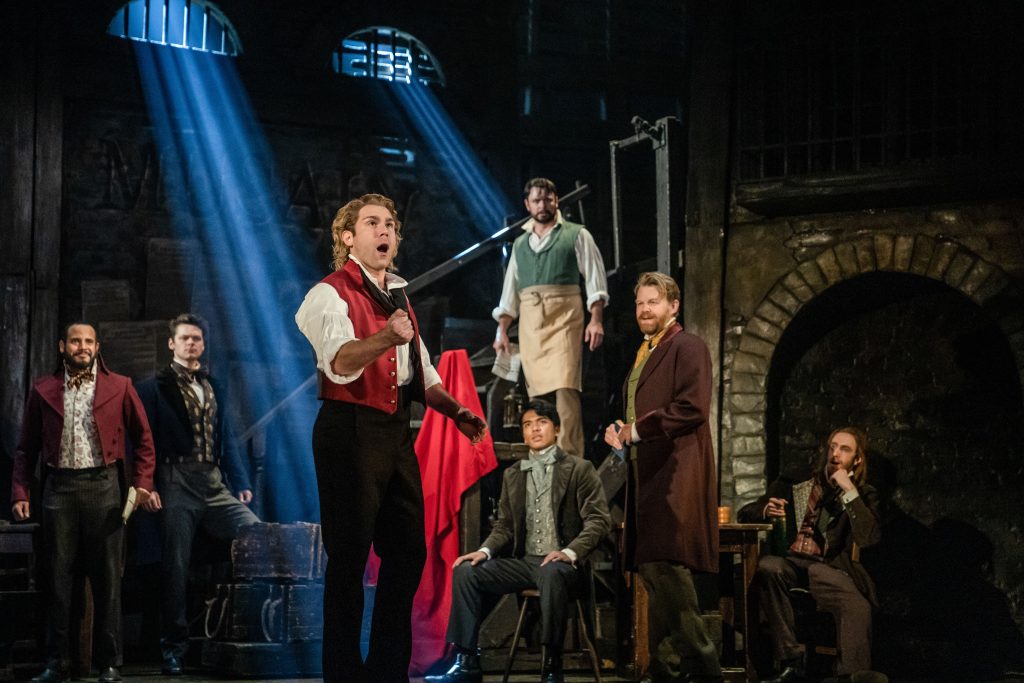
The set transitions—from rural scenes to cityscapes of poverty—were seamless and visually striking, especially the dilapidated apartment buildings that framed each side of the stage and towered massively over the audience.
The superb 100% vocal performances and Will Curry‘s unprecedented musical direction brought out the performers’ vocal strengths, and the perfectly timed sound effects brought the story to life.
The performance opens with a dark, haunting scene that immediately pulls the audience into Valjean’s harrowing journey. Cartell’s portrayal of Valjean was impassioned and authentic, immersing the audience in his struggles from the very first moments. His dynamic vocal range shone through, particularly during the emotional performances of “Soliloquy” and “Who Am I.”
A poignant moment occurs when the Bishop of Digne (Randy Jeter) offers Valjean solace, only for Valjean to steal silver from him. When caught, the bishop clears his name, initiating a transformation in Valjean to become a man of virtue.
Cartell’s vocal intensity in these scenes captured Valjean’s inner turmoil leaving the audience visibly moved, Javert, the unwavering police inspector is obsessed with enforcing the law, creating a powerful conflict within the story.
Boyd’s deep voice and commanding presence shone during his performance of “Stars,” where he stands proud and resolute in his moral duty to bring Valjean to justice. The contrast between Cartell’s smooth tenor and Boyd’s resonant bass vocals accentuated the moral opposition between their characters. The audience could feel the tension of their characters’ opposing natures.
Valjean transforms himself into a respected factory owner and mayor. Fantine, played by Haley Dortch, an unwed mother, faces devastating circumstances. Dortch’s rendition of “I Dreamed a Dream” was particularly moving, as was her duet with Cartell in “Come To Me.” Fantine pleads for Valjean to find and care for her daughter, Cosette (Delaney Guyer), which deepens the emotional stakes and brings the audience into the story further.
The production finds brief levity with the Thénardier (Matt Crowle) and (Victoria Huston-Elem), whose cunning greed and humorous antics provide a bit of much-needed comic relief. Their young, pampered daughter Eponine (Mya Rena Hunter) was introduced here, and Valjean rescues Cosette by paying the Thénardiers so he can take her in Paris. Cosette is not aware of Valjean past.
As revolution brews, the Barricade Boys, led by Marius (Jake David Smith) and Enjolras (Devin Archer), prepare for their uprising. Marius, captivated by Cosette, asks Eponine to find her and warn her to flee the coming danger. Eponine, though secretly in love with Marius, agrees, later returning to fight at the barricade.
Valjean, learning of Cosette’s love for Marius, sets out to find and protect him. In the process, he encounters Javert, who, disguised as a spy, is captured by the revolutionaries. Valjean confronts Javert and instead of ending his life he sets Javert free, a profound act that leaves Javert grappling with his rigid view of the law and the mercy he was given so freely.

In a dramatic moment, Javert’s inner turmoil comes to life as the visual effects of a bridge moving upward simulates his spiraling thoughts, making his eventual fate even more impactful.
The barricade scene is visually captivating, with the remnants of the city transformed into a towering, formidable barrier against the authorities. The powerful sound design immerses the audience in the chaos of the battle—thunderous booms and the smell of gun smoke make the moment feel all too real. The tragic loss of young revolutionaries’ lives particularly Eponine’s, hits hard. As Eponine is shot, she clings to Marius while dying.
Mya Rena Hunter commanded the stage with her masterful presence, and raw emotion embodying the passion of her character. Her duet with Marius, “A Little Fall of Rain,” was delivered with such emotional depth and sincerity that it deeply resonated with the audience.
Valjean discovers Marius, severely injured, and carries him to safety, praying to God to spare his life. He delivers a heartfelt rendition of “Bring Him Home. The scene’s immersive design, with the characters moving through the dark, murky canals, feels almost 3D, drawing the audience into the journey alongside the characters.
Les Misérables captured the many forms of misery prevalent during its time—struggles that, in many ways, still resonate today. Yet, amid the despair, there are glimmers of hope, forgiveness, and redemption and offer valuable lessons on how we can all work to lessen the burdens of ourselves and others. While this adaptation portrays a world rife with hardship and oppression, it is undoubtedly worth experiencing, all combined to make this production truly a must see, perhaps even more than once.
 © 2025 CleveRock Music Portal. A PROUD SHAPE CLEVELAND PRODUCTION